
The Biogas Plant
Four tanks.
Four tasks.
Follow the substrate’s path through the plant. For each station, we show the requirements that apply there and which of our agitators are designed for them.
Receiving Pit
Here, the substrate is received, homogenised, and prepared for the digester. Robust agitators are required to reliably break up floating and settled layers.
Digester
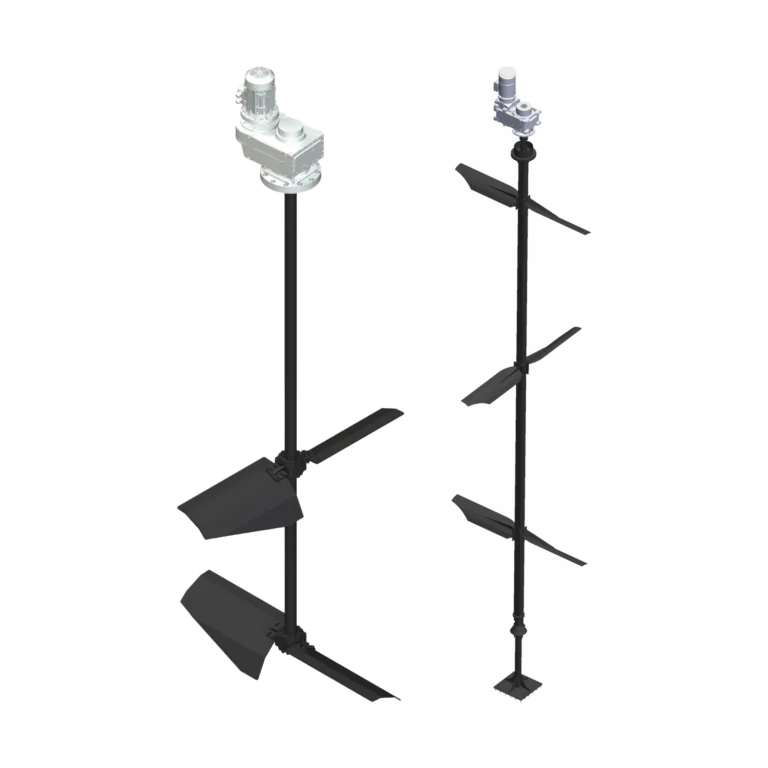
Most of the gas yield is generated in the digester. Uniform mixing keeps temperature and nutrients homogeneous in the tank and prevents dead zones – even with high dry matter content.
Secondary Digester
The secondary digester extracts the remaining gas potential from the substrate. Here too, slow-running agitators work particularly efficiently and move large quantities of substrate uniformly.
Digestate Storage
Varying filling levels, long retention times: In digestate storage, the reach and flexibility of the agitator are crucial. Before spreading on the field, the substrate must be homogeneous again.
Challenges in the Tank
What happens in the tank
determines the agitator.
Six typical conditions in biogas plants – and which agitator we recommend first for each. In practice, several factors often combine; we will clarify the final design with you.
High Dry Matter Content
Viscous substrates require mixing elements that provide powerful propulsion without causing energy consumption to skyrocket.
Fluctuating Filling Level
Irregular feeding and removal change the filling level – the agitator must remain effective at every height.
Floating and Settled Layers
Fibers on top, sand at the bottom: Layers must be reliably broken up so that no volume is lost.
Large Tanks
Diameters up to 50 meters demand a long reach.
Limited Installation Space
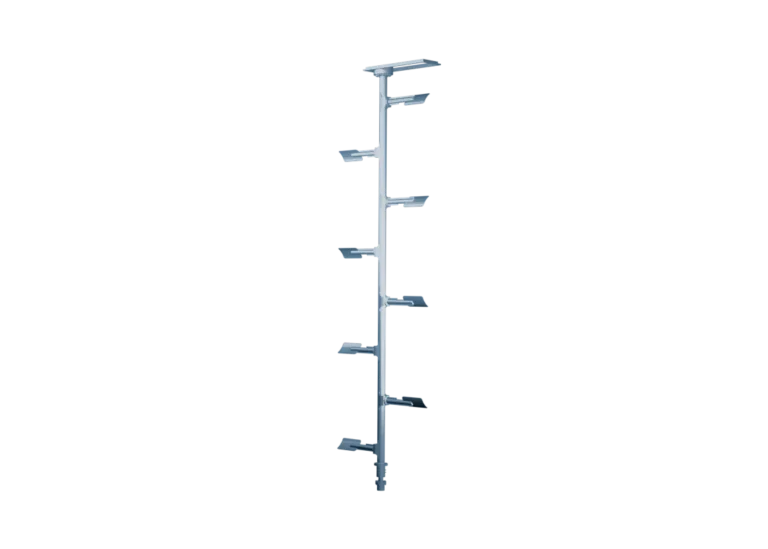
Where there is no space laterally, the path leads upwards – vertically installed, up to 12 meters in length.
High Up
In central agitator digesters, consistently good mixing is of great importance.
Why Mixing Matters
Uniformly agitated,
more gas harvested.
Homogeneous mixing keeps temperature and nutrients evenly distributed in the tank, prevents floating and settled layers, and ensures that the entire tank volume contributes to gas production – with fluctuating substrates as well as varying filling levels.
Gas Yield
The entire volume is utilized
Energy Consumption
Slow-running, efficiently agitated
Service Life
Robustly designed for long-term operation
Beyond the Biogas Plant
The same principle,
different tanks.
Our agitator technology is used wherever media must be reliably kept in motion.
Agriculture & Slurry
Slurry storage and receiving pit – robust, low-maintenance, and designed for long operating times under harsh conditions.
Wastewater Treatment Plants & Wastewater
Aeration basins, digestion towers, and sludge treatment – with materials that withstand aggressive media like sewage sludge.
Industry
Individual mixing tasks in industrial processes – tailored to tank geometry, material, and medium.
Special Solutions
Is your application not listed?
Then we will develop it.
We constantly implement special solutions for tank geometries, media, and processes that cannot be forced into a standard scheme. Contact us – we will develop the right agitator together with you.